
Pedagogical Synthesis of Upper Cavity Resonance and Gaelic Phonological Softening: A Classical-Crossover Vocal Framework
- Letitia Hill
- Jun 16
- 13 min read

By Letitia Kelly
Acoustic Principles of Upper Cavity Resonance
To achieve a pure, resonant tone in classical-crossover and traditional vocal performance, the singer must master the acoustics of the upper resonators.1 Vocal resonance is the process by which the basic sound waves generated by the larynx are modified, filtered, and amplified as they travel through the vocal tract.1 While the vocal folds dictate the fundamental pitch, the pharynx, oral cavity, and nasal cavity act as natural physical filters that define the unique timbre and projection of the voice.1
The vocal tract contains both conductive and sympathetic resonators.1 Conductive (forced) resonance involves physical vibrations traveling along the bones, cartilages, and muscular structures of the skull, neck, and upper chest.1 Although these vibrations provide crucial tactile feedback to the vocalist, they contribute minimally to the external acoustic sound field due to tissue absorption.1 Conversely, sympathetic (free) resonance occurs when air column vibrations inside the vocal tract cavities interact with the surrounding structures without direct physical contact.1 What the listener hears is primarily the product of this sympathetic, air-filtered resonance.1

The pharynx is the largest and most adjustable resonating space, subdivided into the laryngopharynx, oropharynx, and nasopharynx.1 When the pharyngeal constrictor muscles are fully relaxed, the throat expands, creating an optimal shape to amplify high-frequency overtones.1
The nasal cavity acts as a non-adjustable resonator with a fixed structure.1 It is brought into the acoustic mix solely by the movement of the soft palate (velum).1
A central challenge in vocal pedagogy is distinguishing between "nasality" and "mask resonance" 6:
● Nasality: When the soft palate is lowered, the velopharyngeal port opens, allowing sound waves to enter the nasal passages.6 This creates "antiresonance" or "white space," where the complex, tissue-dense structures of the nasal cavity absorb and cancel out high-frequency overtones, producing a pinched, twangy, and muffled tone.1
● Mask Resonance (Forward Placement): When the soft palate is elevated, it seals off the nasal cavity.1 Sound waves exit exclusively through the oral tract, but their high-frequency harmonics excite the bones of the face and sinuses, creating a bright, projecting tone without throat strain.2 1
Phonetic Landscapes of Gaelic and Irish Traditional Singing
Singing in Irish Gaelic introduces complex phonetic demands.12 The language relies on a structural distinction between "broad" (velarized) and "slender" (palatalized) phonemes.15 This distinction alters the shape of the oral cavity and the position of the tongue, presenting a unique challenge when singing long, sweeping melodies.15
Broad Vowels (Á, Ó, Ú) ---> Retracted Tongue / Rounded Lips ---> Open Pharynx Required Slender Vowels (É, Í) ---> Forward Arched Tongue / Flat Lips ---> Risk of Throat Clamping Consonant Mutations ---> Lenition (Séimhiú) / Eclipsis (Urú) ---> Airflow Interruption
The Broad and Slender Paradigm
Irish vowels are categorized into two classes that dictate how adjacent consonants are pronounced 15:
● Broad Vowels (Á, Ó, Ú): Produced by retracting the tongue and arching the back of the tongue toward the soft palate.15 The lips are rounded, which extends the vocal tract and darkens the sound.15
● Slender Vowels (É, Í): Produced by arching the front of the tongue forward toward the hard palate and teeth.15 The lips remain open and relaxed.15
Consonants adjust their pronunciation based on these adjacent vowels.15 Broad consonants are pronounced with rounded lips and a slight "u"-glide.15 Slender consonants are pronounced with the tongue pressed forward against the teeth or hard palate, accompanied by a "y"-glide (palatalization).15
Consonant Mutations: Lenition and Eclipsis
Irish orthography features two primary consonant mutations that alter the flow of breath during singing 16:
1. Lenition (Séimhiú): Softens a consonant by adding an "h", transforming stop consonants into fricatives or silent glides.16 For example, broad bh and mh mutate to a [w] or [v] sound, while ch mutates into a voiceless velar fricative [x] (resembling the "ch" in loch).16
2. Eclipsis (Urú): Places a voiced consonant before an unvoiced one, silencing the original consonant.16 For example, b becomes mb (pronounced [m]), and c becomes gc (pronounced [g]).16
For a non-native speaker, executing these mutations while sustaining a soaring melody can be difficult.12 This challenge is demonstrated in the phonetic transcription of the traditional song "A Ghrásta Iontaigh" :
/a.ˈɡɾaːsˠ.t̪a. ˈɪn.t̪ə əs bʲɪ.an fˠuəmʲ/
Here, the vocalist must rapidly transition from a broad, velarized dental plosive [t̪ˠ] in ghrásta to a slender, palatalized nasal [nʲ] in iontaigh.20 These rapid tongue shifts can cause the throat to tighten, disrupting the stable, open-throat configuration required for classical-crossover projection.5
Diphthong Articulation
Traditional Gaelic singing handles diphthongs differently than standard English.23 In classical English singing, the vocalist sustains the primary vowel and quickly slides through the off-glide.24
In contrast, traditional Scots and Irish Gaelic singing often prolongs the second vowel.26 For example, the word aibhne is pronounced as a sustained glide [eyev-nyuh].27 The common diphthongs—ae, ao, aoi, ea, ei, ia, and ua—require a flexible tongue to navigate these vowel-to-vowel transitions without losing forward acoustic placement.16
The Mary Jane Lamond Method: Consonant Softening and Earthy Phrasing
Mary Jane Lamond’s vocal style combines modern production with traditional Cape Breton Scottish Gaelic performance.28 Understanding her vocal background and physical approach is essential to reverse-engineering her technique.28
Cape Breton Earthiness versus Ethereal Scottish Style
With a background in Celtic Studies from Saint Francis Xavier University, Lamond developed an appreciation for the oral traditions of Nova Scotia’s Gaelic settlers.28 She contrasts her Cape Breton vocal style with the more ethereal, high-pitched approach of native Scottish Gaelic singers 28:
"I would describe Cape Breton singers as being closer to the floor, earthier and not so ethereal. In our style, the rhythm is in everything, even the slower songs." 28
This earthy quality is grounded in a robust, low-laryngeal posture and a silken alto register.7 The style is driven by a strong rhythmic pulse (cuisle), rooted in the physical labor of milling or "waulking" cloth.29 In waulking songs like "Hoireann ó Rathill iù ó", the vocal rhythm mimics the physical pounding of wool against wood.29 This physical grounding ensures that the larynx remains stabilized and relaxed, avoiding the high-laryngeal tension common in classical training when singing high, rapid passages.7
Softening the Fricatives
A key element of Lamond’s vocal technique is her handling of the velar and palatal fricatives (CH, GH, DH).28 In spoken Gaelic, these sounds require a constricted vocal tract 25:
● Broad CH ([x]): A voiceless velar fricative produced by arching the back of the tongue against the soft palate, creating a harsh, scraping sound.19
● Slender CH ([ç]): A voiceless palatal fricative produced by arching the tongue forward, sounding like a forceful "h" and "y" run together.19
Sustaining these fricatives in a high melodic line can disrupt the airflow and drop subglottic pressure.2 Lamond resolves this by softening the fricatives.28 Rather than executing a harsh velar scrape, she lowers the posterior arch of the tongue, softening the broad [x] into a gentle, aspirated [h].19
She modifies the slender [ç] into an airy, palatal semivowel glide closer to [j].19 This softening maintains a steady stream of air through the vocal tract, preserving legato phrasing and allowing the sound to flow smoothly into the subsequent vowel.25
The Inger Lise Hope Technique: Crystal-Clear Head-Mix and High-Frequency Tuning
In contrast to the earthy, low-register focus of Cape Breton folk music, Norwegian vocalist Inger Lise Hope—winner of The Voice Norway 2024—demonstrates a contemporary classical-crossover head-mix technique.35 Her performances in leading theatrical roles (such as Belle in Beauty and the Beast and Maria in The Sound of Music) highlight a clear, resonant vocal delivery with precise dynamic control.35
Pharyngeal Voice and Passaggi Blending
Hope’s technique relies on the "pharyngeal voice," an acoustic bridge that smooths the transition between the chest and head registers.5 For female vocalists, navigating the passaggi (register transitions) often results in a sudden change in tone.25 Hope avoids this by narrowing the epilaryngeal space while keeping the larger pharyngeal cavity wide and relaxed.1 This configuration balances thyroarytenoid and cricothyroid muscle tension, allowing her to transition smoothly from chest voice into a powerful, resonant head-mix.5
Formant Tuning and Acoustic Ring
To achieve her clear tone, Hope utilizes "formant tuning," adjusting her vocal tract to align with the harmonics of her sung pitch.9 By lifting the middle of her tongue and maintaining a high soft palate, she creates a narrow epilaryngeal tube.5 This acoustic adjustment boosts frequencies in the 2000 Hz - 4000 Hz range.2
This frequency boost, known as the "singer's formant," gives her voice a ringing quality (squillo) that projects over loud instrumental arrangements without requiring extra breath pressure.2 This acoustic strategy reduces mechanical stress on the vocal folds, helping to prevent vocal fatigue.2
Connemara Sean-Nós: Aesthetic Pillars and Comparative Models
Connemara (Connacht) sean-nós is widely recognized as the most highly ornamented and melismatic of the regional Irish vocal styles . As an unaccompanied solo art form, its delivery relies on a free rhythmic pulse (cuisle), a deliberate omission of theatrical vibrato, and a unique nasal head placement known as the neá .

Methodological Integration for Áighne Ní Chadhain
Áighne Ní Chadhain represents the living, intergenerational peak of the Connemara female lineage, having ¢›learned the art form directly from her grandmother (seanmháthair).4 By incorporating the methods of Mary Jane Lamond and Inger Lise Hope, Ní Chadhain can expand her technical capability to navigate soaring, high-register traditional melodies without losing her authentic Gaelic foundation.4

1. Incorporating Mary Jane Lamond's Phonetic Softening & Earthy Phrasing
● Fricative Softening for Melismatic Continuity: In traditional Connemara singing, the florid, melismatic lines are heavily ornamented . When Ní Chadhain encounters words with broad velar fricatives like ch in loch or slender fricatives in oíche, the physical effort to produce a harsh velar scrape [x] or a sharp hiss [ç] can cause her tongue root to retract and pull downward.7 By adopting Lamond's method, she can lower the back of her tongue, transforming the broad [x] into a smooth, aspirated [h]19 and the slender [ç] into a soft palatal glide [j].19 This softening keeps her jaw relaxed 7 and allows her voice to flow smoothly into the subsequent vowel without losing the momentum of the melody.25
● Rhythmic Anchoring and "Earthy" Pulse: While Connemara sean-nós relies on a flexible, free rhythm , incorporating Lamond's robust, "earthy" rhythmic pulse—inspired by Cape Breton waulking and milling tempos 28—can stabilize Ní Chadhain's larynx during faster passages (such as puirt-á-beul). Keeping the physical sensation of the singing "closer to the floor" 28 stabilizes her lower laryngeal posture 7, preventing the throat constriction that often occurs under performance stress.5
● Modern Dynamic Interpretation: Traditional sean-nós is performed without dynamic variation . By adopting Lamond's approach of using controlled dynamics as a modern interpreter 1, Ní Chadhain can introduce subtle volume arches to emphasize emotional peaks. This creates a bridge between her traditional a cappella roots and modern crossover arrangements when performing with instrumental ensembles.10
2. Incorporating Inger Lise Hope's Crossover Registral Mastery
● Smooth Registral Blending via Pharyngeal Voice: Traditional female sean-nós singing often features a thin, straight tone or a chest-heavy squeeze when ascending to higher notes . By incorporating Hope's pharyngeal voice—which narrows the epilaryngeal space while keeping the larger pharyngeal cavity relaxed 1—Ní Chadhain can create an acoustic bridge. This balance of muscular coordination will allow her to transition seamlessly from her warm, tactile chest register into a soaring head-mix without sudden register breaks or vocal strain.5
● Formant Tuning and Mask Ring over Nasal Squeeze: Traditional Connemara singing relies heavily on the nasal head drone (neá) to stay on pitch . However, over-reliance can result in a pinched, overly nasal tone that lacks carrying power in modern concert spaces . By practicing Hope's formant tuning—elevating the soft palate to close the nasal cavity while narrowing the epilarynx 1—Ní Chadhain can redirect her resonance to achieve a brilliant forward placement (squillo).5 This allows her voice to project effortlessly over large modern halls without requiring excessive nasal constriction.2
● Pure Straight-Tone Sensation: To preserve the traditional straight tone of the Connemara style , Ní Chadhain can adapt Hope's head-mix by balancing cricothyroid muscle activation with a steady, unforced stream of air.2 This prevents both classical-style vibrato and vocal-fold strain, keeping her high-frequency head-mix clear and focused.
Synthesizing the Lamond-Hope Crossover Methodology
Combining Mary Jane Lamond’s phonetic softening with Inger Lise Hope’s head-mix technique offers a practical solution to a major challenge in Celtic singing: maintaining a clear, resonant tone while navigating the complex consonant mutations of soaring Gaelic melodies.5

The Physiology of the Integrated Technique
When a vocalist sings a high, sweeping melody in Irish Gaelic, encountering a velar or palatal consonant can cause a reflex where the tongue root pulls backward and downward.7 This retraction drops the soft palate and tenses the larynx, interrupting the high-frequency formant tuning required for a clear head-mix.5
By applying Lamond's softening technique, the singer lowers the back of the tongue during consonants, transforming harsh velar sounds into smooth, aspirated glides.19 This softening prevents tongue-root tension and keeps the larynx relaxed.7
Simultaneously, by adopting Hope's pharyngeal and mask resonance placement, the singer keeps the soft palate elevated and the epilaryngeal space narrow.5 This maintains high-frequency projection, allowing the vocalist to transition from consonant to vowel while keeping a stable, resonant tone.2
Comparative Analysis of Vocal Models
The following table compares different vocal models, highlighting their laryngeal postures, velopharyngeal port states, and stylistic features.
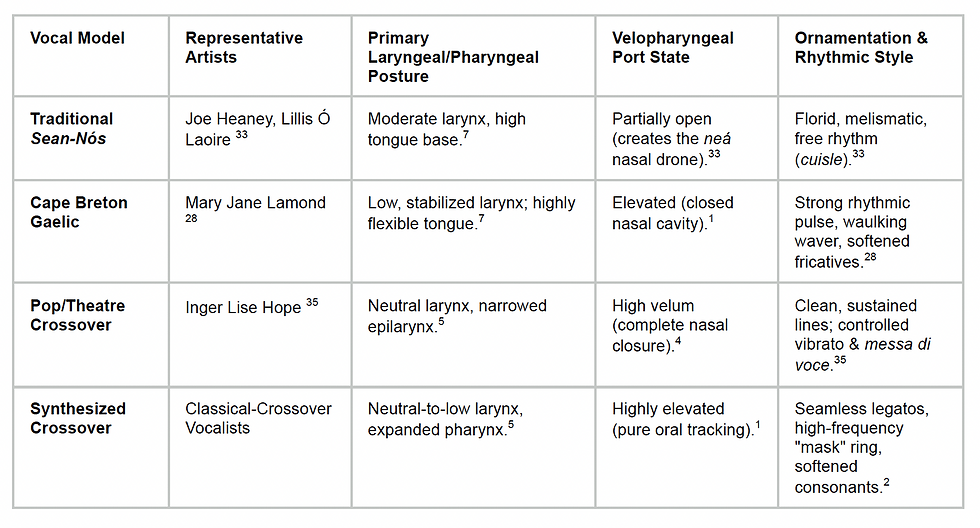
Irish Gaelic Vowel and Diphthong Acoustic Modifications
This table outlines specific vowel and diphthong modifications designed to maintain a clear tone in the higher register.

Pedagogical Protocol Suggestions
To learn this synthesized technique, you should follow a progressive training sequence that establishes velar control, isolates pharyngeal resonance, and integrates these adjustments into performance.1

Phase 1: Velum Isolation and Palatal Control
1. The Lateral Hand Breath: The student places a flat, clean hand laterally between the teeth and inhales gently over it.7 This stretch elevates the soft palate and releases the larynx, opening the throat before singing.7
2. The Surprised Inhalation: The student inhales suddenly through the mouth, as if surprised.9 This action elevates the levator veli palatini muscles, raising the soft palate.1
3. The Occlusion Test: While sustaining a broad AH [a] vowel, the student pinches and releases the nostrils.1 The student must adjust the physical sensation until pinching the nose produces no acoustic change, indicating that the velopharyngeal port is sealed.1
Phase 2: Pharyngeal Voice and Mask Sensation
1. The Descending [ŋ] to Vowel Sigh:
○ The student sings the word "sing" and sustains the final "-ng" [ŋ] position.1 The tongue is arched loosely against the boundary of the hard and soft palates.1
○ The student transitions directly from the nasal consonant into an AH [a] vowel while executing a descending vocal slide.1
○ This sequence is repeated on a descending five-note scale ( 5-4-3-2-1 or so-fa-mi-re-do).1 This teaches the tongue to release forward from a nasal consonant directly into an open, resonant vowel.1
2. The Pharyngeal "Yee-Yah" Glides:
○ The student sings the syllable YEE [ji] on a comfortable pitch.5 The "y" semivowel naturally draws the tongue forward, releasing tongue-root tension.22
○ Without losing the forward buzzing sensation in the mask, the student morphs the vowel into a tall JAH [ja].5
○ The exercise is expanded into octave slides to train the head-mix to maintain forward ring as pitch increases.2
Phase 3: Fricative Softening and Vowel Morphing
1. Fricative Softening Drill:
○ The student pronounces the Irish word loch with a full, rasping broad CH [x] at the end.16
○ The student then sings the word on a sustained pitch, but intentionally lowers the posterior tongue arch, widening the oral passage.15 This softens the friction, turning the [x] into a gentle, aspirated [h].19
○ The student practices transitioning this softened fricative directly into a soaring vowel (e.g., loch to lo-ah), ensuring that the breath flow remains uninterrupted and the vocal tract stays open.1
○ Similarly, the slender CH [ç] (as in oíche) is softened from a harsh hiss to a light, breathy palatal glide, moving smoothly into the subsequent vowel sound (e.g., EE-hyeh).19
2. Vowel Morphing for High Register:
○ To sing a soaring melody on a slender Í [i]or É [e] vowel, the narrow shape can cause the throat to clamp.15
○ The instructor teaches the student to slightly "morph" the vowel.25 As the pitch ascends, the student is instructed to gently lower the jaw and relax the lips, shifting the narrow [i]("meet") slightly toward the more spacious [I] ("pit") or [e] toward [ε] ("get").15 This maintains high-frequency projection while expanding the pharyngeal cavity.1
Pedagogical Lesson Protocol and Progression
This table summarizes the structured training sequence, defining target mechanisms, objectives, and success indicators for each step.

Works cited
1. RESONANCE – Vocal Techniques for the Instrumentalist, accessed May 28, 2026, https://kstatelibraries.pressbooks.pub/vocal-techniques/chapter/resonance/
2. Vocal resonance: 35% projection boost, less strain - TMRG Solutions, accessed May 28, 2026, https://tmrgsolutions.com/blogs/articles/vocal-resonance-projection-boost-less-strain
3. Vocal resonation - Wikipedia, accessed May 28, 2026, https://en.wikipedia.org/wiki/Vocal_resonation
4. Vocal Resonance - vocal technique, accessed May 28, 2026, https://vocaltechnique.co.uk/vocal-resonance/
5. Improve Your Singing with Pharyngeal Resonance, accessed May 28, 2026, https://www.londonsinginginstitute.co.uk/pharyngeal-resonance/
6. “Nasal Resonance” - VoiceLessons.com, accessed May 28, 2026, https://www.voicelessons.com/blog/knowledge/nasal-resonance
7. Nasality in the Tenor Voice - David Jones, accessed May 28, 2026, https://voiceteacher.com/nasal_tenor.html
8. Nasal Resonance Vs. Nasality In Singing - Voice Lessons, accessed May 28, 2026, https://voice-lessons.com/nasal-resonance-vs-nasality/
9. Resonance - VOCAL TECHNIQUE, accessed May 28, 2026, https://www.vocaltechnique.info/resonance.html
10. Follow Your Nose: Nasal Resonance Defined - Arabellas Voice Studio, accessed May 28, 2026, https://arabellavoicestudio.com/learning-functional-vocal-anatomy/
11. Vocal Placement - Placing the Voice Properly, accessed May 28, 2026, https://www.cavenessvoice.com/blog/vocal-placement-placing-the-voice-properly
12. Traditional Gaelic Singing - MARGARET STEWART, accessed May 28, 2026, http://www.margaretstewart.com/margarets-blog/traditional-gaealic-singing
13. Songs in Irish with Muireann Nic Amhlaoibh - Online Academy of Irish Music, accessed May 28, 2026, https://oaim.ie/song-lessons/songs-irish/
14. Singing in Irish Gaelic - Bitesize Irish, accessed May 28, 2026, https://www.bitesize.irish/blog/singing-in-irish-gaelic/
15. The Sounds of Irish — Gaeltacht an Oileáin Úir | North American ..., accessed May 28, 2026, https://www.gaeilge.ca/lessons/the-sounds-of-irish
16. Irish Language Pronunciation Guide - Gaelscoil Online, accessed May 28, 2026, https://www.gaelscoilonline.com/blog/irishpronunciationguide
17. Beginners - Little by Little - Grammar - The definite article - LearnGaelic, accessed May 28, 2026, https://learngaelic.scot/littlebylittle/sounds/index.jsp
18. Fr Michael O'Flanagan's booklet on Irish Phonetics 1904 - Carrowkeel, accessed May 28, 2026, https://www.carrowkeel.com/frof/1904booklet.html
19. The Sounds of Irish Gaelic, accessed May 28, 2026, https://www.bitesize.irish/blog/the-sounds-of-irish-gaelic-part-1/
20. Does anyone know where I can find IPA lyrics for Irish songs? - Reddit, accessed May 28, 2026, https://www.reddit.com/r/Irishmusic/comments/iup1o3/does_anyone_know_where_i_can_find_ipa_lyrics_for/
21. Phonetic Key to O'Growney's Simple Lessons in Irish, accessed May 28, 2026, https://www3.smo.uhi.ac.uk/oduibhin/teangeolas/ogrowney.htm
22. Singing consonants can be a mouthful. Here's how to get them right - Kathleen Connell, accessed May 28, 2026, https://kathleenconnell.com.au/singing-consonants-can-be-a-mouthful-heres-how-to-get-them-right/
23. How to sing songs from other cultures more authentically - From the front of the choir, accessed May 28, 2026, https://blog.chrisrowbury.com/2017/03/how-to-sing-songs-from-other-cultures.html
24. Vocal and Choral Techniques, accessed May 28, 2026, https://www.singfccc.org/wp-content/uploads/2019/04/Vocal-Choral-Techniques-Fairfield-U.pdf
25. ARTICULATION – Vocal Techniques for the Instrumentalist, accessed May 28, 2026, https://kstatelibraries.pressbooks.pub/vocal-techniques/chapter/articulation/
26. Lowland Scots pronunciation, accessed May 28, 2026, https://archive.org/download/cu31924081114674/cu31924081114674.pdf
27. The Unofficial Guide to Pronouncing Gaelic, accessed May 28, 2026, https://old.cuhwc.org.uk/book/export/html/408
28. Mary Jane Lamond - RootsWorld, accessed May 28, 2026, https://www.rootsworld.com/interview/lamond.html
29. Lamond, Mary Jane | Encyclopedia.com, accessed May 28, 2026, https://www.encyclopedia.com/education/news-wires-white-papers-and-books/lamond-mary-jane
30. Mary Jane Lamond, accessed May 28, 2026, https://maryjanelamond.ca/ 10
31. Mary Jane Lamond & Wendy MacIsaac's Seinn - A Green Man Review, accessed May 28, 2026, https://agreenmanreview.com/music-2/mary-jane-lamond-wendy-macisaac-seinn/
32. The Songs of Fionn mac Cumhaill: An Historical and Musicological Analysis of Indo-European Musical Poetics in Ireland, Scotland - OUR Archive - University of Otago, accessed May 28, 2026, https://ourarchive.otago.ac.nz/view/pdfCoverPage?instCode=64OTAGO_INST&filePid=13397181420001891&download=true
33. Sean-nós singing - Wikipedia, accessed May 28, 2026, https://en.wikipedia.org/wiki/Sean-n%C3%B3s_singing
34. Cadal Ciarach Mo Luran – Cànan tro Òrain - Atlantic Canada Pressbooks Network, accessed May 28, 2026, https://pressbooks.atlanticoer-relatlantique.ca/gaelicsong/chapter/gaelic-song-education-project-bru-dhearg/
35. BIOGRAPHY - Inger Lise Hope, accessed May 28, 2026, https://www.ingerlisehope.no/bio-eng
36. Inger Lise Hope 2026 - Topp Arrangement, accessed May 28, 2026, https://www.topparrangement.no/en/inger-lise-hope/
37. Developing the Pharyngeal Voice - an Old-School Approach, accessed May 28, 2026, https://voice-lessons.com/pharyngeal-voice-development/
38. Performance style and practice in the sean-nós singing tradition. - Gráinne Campion, accessed May 28, 2026, https://grainnecampion.wordpress.com/2013/03/21/performance-style-and-practice-in-the-sean-nos-singing-tradition/
39. Identify and describe the features commonly found in Sean-Nós singing. (2010 Q5 B iii) | A1 Sample Answer, accessed May 28, 2026, https://studyclix.blob.core.windows.net/static/content/file/uploads/c/c616a85b-633c-4b4c-ae45-c05f4f77be9b.pdf
40. Sean Nós Singing - Leaving Cert Music, accessed May 28, 2026, https://leavingcertmusic.weebly.com/sean-noacutes-singing.html
41. Vowel Shapes and Lengths for Contemporary Singing - Judy Rodman, accessed May 28, 2026, https://judyrodman.com/vowel-shapes-and-lengths-for/
42. Hii i have some questions about nasal resonance and mask : r/singing - Reddit, accessed May 28, 2026, https://www.reddit.com/r/singing/comments/1se2fa0/hii_i_have_some_questions_about_nasal_resonance/
Comments