
Spatial and Genealogical Reconstruction of the Riley Family Burials in Blue River Cemetery, Thorncreek Township, Whitley County, Indiana
- Letitia Hill
- Jun 16
- 7 min read

by Letitia Kelly
Historical and Geographical Foundations of Blue River Cemetery
The establishment of Blue River Cemetery in Thorncreek Township, Whitley County, Indiana, represents a vital institutional anchor for the early frontier families of northeastern Indiana. The burial ground was officially deeded on January 21, 1851, when pioneering settlers Nathaniel and Elizabeth Gradeless (historically recorded in early deed books as Greadless) granted the parcel to the Commissioners of Whitley County for the token consideration of exactly one dollar. This transaction, which consolidated a public cemetery for the township, was formally recorded on January 28, 1856, in Deed Book H, Page 531.
The original tract encompassed ninety-four square rods of land located in Section 24, Township 32 North, Range 10 East, precisely mapped as beginning at a point on the section line 50.24 rods west of the southeast corner of Section 24, extending North 9.40 rods, West 10 rods, South 9.40 rods, and East 10 rods to the starting point. Geographically, the cemetery is situated on the north side of County Road 300N, positioned between Riley Road and County Road 350E, directly across from the local Methodist church, with its exact modern global positioning coordinates established at 41°12'26"N, 85°25'38"W.
The cemetery land itself was originally utilized as a private burying ground for the Gradeless family before its public dedication. Local oral tradition suggests that Equilla Gradeless Pence was the first burial on this scenic hill, a spot where she had frequently played during childhood; her young son, George C. Pence, was laid to rest beside her just two years later, initiating the communal use of the plot.
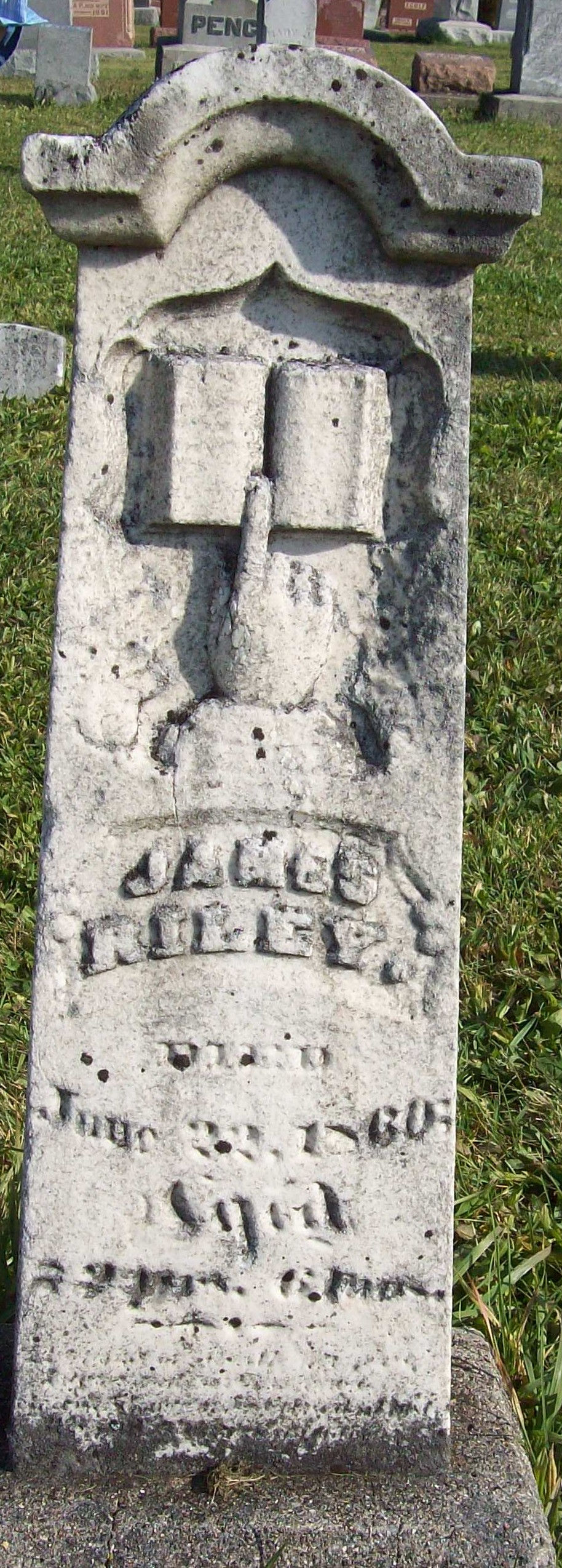
When the Riley family migrated to Whitley County in 1842, they arrived during the initial phase of wilderness clearing. Alongside the Gradeless, Pence, and Baughan families, the Rileys were among the first generation of frontier settlers to clear the heavy timber of Thorncreek Township. Consequently, when the family patriarch, James Riley, died in June of 1860, his sons utilized this communal ground, beginning a multi-generational spatial sequence of family burials.
The Linear Burial Sequence of the Riley Pioneers
The spatial organization of the early Riley family graves is preserved in the original field logs of Nellie Riley Raber, a prominent local genealogist whose own ancestors were part of the 1842 settler cohort. Rather than organizing burials alphabetically, the Raber field logs preserved the exact physical order of the graves as they were laid out linearly across the landscape. This structural mapping captures the physical sequence of the family row, illustrating how the sons were physically aligned relative to their father, James Riley.
The Raber ledger records these burials through numerical entries that run sequentially across the plots. The numerical jumps between entries indicate where other community members or open spaces separated the family segments, yet the relative progression remains clear :
Entry 85 (Samuel Riley): Situated at the northern end of the early family alignments, representing one of the first sons of James to clear and settle the land.
Entry 109 (James Riley): The central physical and genealogical anchor of the pioneer plot.
Entry 110 (Johnson Riley): Positioned immediately adjacent to the father, establishing a direct familial link.
Entry 142 (Frank/Francis Riley): Positioned further down the family line plot progression, representing the southern or eastern boundary of the early family tract.
This physical sequence demonstrates a classic patriarchal spatial layout, where the founder of the local line is flanked directly by his sons, establishing an enduring monument to their collective migration and settlement.
Structural Demography of the Riley Family Plot
The following comprehensive database consolidates all documented individuals bearing the Riley surname buried within the Blue River Cemetery boundaries, combining the data from the Nellie Raber field logs, historical estate records, and local grave registries.
Name | Chronological Lifespan / Vital Dates | Physical Cemetery Location / Coordinates | Kinship Ties and Historical Context |
James Riley | d. June 22, 1860 (Age: 72 years, 6 months) | Blue River-A-5-13-1 (Raber Entry 109) | Patriarch of the Whitley County Line. War of 1812 Artillery Veteran. Born circa December 1787. His epitaph reads: "The pains of death are past / Labor and sorrow cease...". |
William F. Riley | d. February 11, 1861 (Age: 2 years, 10 months, 2 days) | Lot 109 Blue River-A-5-12-1 | Grandson. Infant son of Johnson and Mary Ann (Smith) Riley. Died during the winter following his grandfather's passing. |
Lawson Riley | d. February 13, 1864 (Age: 15 years, 5 months, 28 days) | Lot 109 Blue River-A-5-11-1 | Grandson. Adolescent son of Johnson and Mary Ann (Smith) Riley. Died during the American Civil War. |
James C. Riley | d. March 21, 1879 (Age: 53 years, 2 months, 24 days) | Lot 110 Blue River-A-5-14-2 | Son of James. Born circa December 1825. Positioned immediately to the south of his father's grave. |
Carl S. Riley | b. 1883 d. 1883 | Lot 85 Blue River-A-9-12-1 | Great-Grandson. Infant son of Samuel S. and Eliza A. Riley. |
Mary A. Riley (née Smith) | d. February 9, 1895 (Age: 66 years, 5 days) | Lot 109 Blue River-A-5-9-1 | Daughter-in-law. Wife of Johnson Riley. Share a headstone listing Jessie Tawney (or Fawney). |
Johnson Riley | b. 1823 (Fayette County, OH) d. March 3, 1901 | Lot 109 / 110 Blue River-A-5-9-3 (Raber Entry 110) | Son of James. Husband of Mary Ann Smith. Pioneered Thorncreek Township alongside his father and brothers. |
Frank (Francis) Riley | Dates unrecorded on stone / missing in field logs | Lot 142 (Raber Entry 142) | Son of James. Brother to Samuel and Johnson. Positioned further down the primary pioneer row progression. |
Charles W. Riley | b. 1867 d. 1919 | Blue River-B-14-8-1 | Grandson. Farmer and heir of the Susan Farner estate in Section 35. Buried in the newer Section B. |
Samuel S. Riley | b. 1851 d. 1920 | Lot 85 Blue River-A-9-10-1 (Raber Entry 85) | Grandson. Husband of Eliza A. Riley. Re-established the northern family plot in Row 9. |
Eliza A. Riley | b. 1850 d. 1943 | Lot 85 Blue River-A-9-10-2 | Spouse. Wife of Samuel S. Riley. Interred adjacent to her husband under a shared marker. |
Mary Hyre Riley | b. 1870 d. 1956 | Blue River-B-14-9-1 | Spouse / Descendant. Interred in Section B directly alongside Charles W. Riley. |
Ernest J. Riley | b. 1892 d. 1966 | Lot 85 Blue River-A-9-13-1 | Great-Grandson. Son of Samuel S. and Eliza A. Riley. |
Lola E. Riley M | b. 1903 d. 1959 | Sheet 177 (Raber Index) | Descendant. Recorded in the family preservation files of Nellie Raber. |
Nellie Riley Raber | b. 1891 d. 19__ | Sheet 177 (Raber Index) | Family Genealogist. Born into the Riley family; dedicated her life to preserving Thorncreek Township cemetery histories. |
Eliza Pumphrey Riley | Dates unrecorded in index | Sheet 23 (Raber Index) | Kinship Entry. Recorded as the mother of Belle Groesbeck (wife of Clyde B. Groesbeck). |
Socio-Spatial and Economic Evolution of the Family Tract
Analyzing the physical layout of these burials reveals several historical trends within the family. The physical positioning of the graves in Section A, Row 5, highlights how the early family handled loss. The patriarch, James Riley, was buried in June of 1860 in the center of the plot (A-5-13-1).
Within four years of his death, the family suffered the loss of two children: two-year-old William F. Riley in 1861 and fifteen-year-old Lawson Riley in 1864. Rather than starting a new row, the family buried these young children in the adjacent plots (A-5-12-1 and A-5-11-1), directly north of their grandfather. This spatial grouping around the elder James reflects a common early American burial pattern, clustering children near a foundational ancestor to represent family unity in death.
Furthermore, the ledger shows a physical shift from Section A to Section B over the decades, reflecting both the growth of the cemetery and the family's changing economic status. Section A contains the original pioneer plots, characterized by close-set, linear rows.
In contrast, burials from the late nineteenth and early twentieth centuries, such as those of Charles W. Riley (1867–1919) and Mary Hyre Riley (1870–1956), were placed in Section B, Row 14. This shift reflects a move toward more spacious, modern cemetery layouts, coinciding with the family's transition from early frontier survival to established farming and landownership.
This socioeconomic transition is documented in the local land and estate records of Thorncreek Township. Under the terms of the will of Susan Farner, signed on June 21, 1900, and probated on February 1, 1902, Charles W. Riley was devised the east half of the southeast quarter of the southeast quarter of Section 35, Township 32 North, Range 9 East. This valuable agricultural land was bequeathed to Charles on the condition that he pay five hundred dollars to Farner’s granddaughter, Alice Tawney, when she reached adulthood.
Farner's will also included significant charitable donations to local churches, including five hundred dollars each to the Thorncreek Bethel and Blue River Bethel Churches of God, and three hundred dollars to the Blue River Circuit to build a local parsonage. This probate record places the twentieth-century Riley family within a prosperous circle of land-owning families, explaining their transition from the simple pioneer rows of Section A to the larger family plots in Section B.
Finally, the preservation of these details is due to Nellie Riley Raber (1891–19__), whose personal connections to the family influenced her research. As a descendant of the 1842 migration, Raber was not merely recording municipal data; she was documenting her own family's history. Her detailed field logs, which she titled the Eternal Cities of Thorncreek, captured not just names and dates, but the physical arrangement of the headstones, saving this spatial family history from being lost to time.
Primary Source Archival Documentation
For the benefit of future genealogical research and to ensure precise scholarly standards, the primary source materials used to reconstruct the Riley family burials are compiled below. These citations provide the exact archival and manuscript contexts for the field logs and ledger maps discussed throughout this report:
Archival Footnote and Endnote Specification
Nellie Riley Raber, Whitley County, Indiana, Cemetery Inscriptions and Family Records, Notebook 1 (Thorncreek Township: Blue River Cemetery Field Notes), digital transcript entries 85, 109, 110, and 142; Historical and Genealogical Society of Whitley County, Columbia City, Indiana (accessed May 17, 2026).
Systematic Bibliographical Entry
Raber, Nellie Riley. Whitley County, Indiana, Cemetery Inscriptions and Family Records. Notebook 1: Thorncreek Township (Blue River Cemetery Master Logs). Preservation Manuscript Collection. Historical and Genealogical Society of Whitley County, Columbia City, Indiana. URL: https://www.whitleycountyin.org/raber01.htm
Analytical Conclusions
The physical and historical record of the Riley family burials in Blue River Cemetery provides a clear picture of frontier settlement, family organization, and community development in Thorncreek Township. The original pioneer layout in Section A, Row 5, shows a structured family unit organized around the patriarch, James Riley. Over the generations, as the family grew and acquired land—as seen in the estate records of Charles W. Riley—their burial locations shifted from these simple linear rows to the larger, modern plots of Section B.
Preserved through the detailed work of Nellie Riley Raber, these physical plots and written records do more than list names and dates. They offer a lasting record of the family's journey, from their arrival as frontier settlers in 1842 to their established place in the agricultural and civic life of Whitley County.

Comments